The alarm went off before the city had fully woken up, and I packed my small suitcase quickly, the way you do when something wonderful is waiting on the other end. The bells of the Duomo rang out over Florence as I walked briskly through the cold November air toward the station, my breath hanging in front of me and my mind already somewhere further south.
Six hours on the train stretched ahead of me, and I welcomed every one of them. Italy unfolds slowly through a train window. The city gave way to the countryside, countryside to the rolling hills and dense forests of Campania, until finally the land opened up and the sea appeared alongside us, silver and endless, carrying me all the way to Bari. With an eager stomach and a fresh mind, I settled in, not yet knowing that the next four days would forever change my taste buds.
I was traveling with a small group of fellow food and wine journalists, and our mission was simple: to discover the heart of Puglia through what grows in its soil, what ages in its cellars, and what is shared, generously and without hurry, around its tables.
Cucina Povera, Reimagined
Before I tell you about a single glass of wine, you need to understand the philosophy that runs through everything in Puglia: cucina povera.
The phrase translates as "poor cooking," and for generations it described what families made from what little they had. Wild greens gathered from the fields, legumes, stale bread given new life, vegetables from the garden, a drizzle of the oil pressed from their own trees. It would be easy to mistake it for a cuisine of the past, a memory of hard times.
That would be a mistake. What I tasted in Puglia was not the food of scarcity but the food of wisdom. Today cucina povera is comfort food in its truest sense: honest, nourishing and deeply healthy, built on tradition and on the plants that have sustained this region for centuries. Some of those very plants are now being studied by researchers for their potential benefits against the ailments we face in modern life. The grandmothers of Puglia, it turns out, were ahead of their time.


Where Wine Is Not Work, but Life
If there is one thing I will carry with me from Puglia, it is the way its winemakers speak about their vines. Not as a product. As family.
At Mazzone, I Parioni, Centovignali and Petrocavallo, I met people who did not rush anything. They slowly pick their vines, allowing the grapes to fully mature on the plant before a single cluster is cut. They stop and listen to what is growing. They watch with patience and let nature develop its true beauty in its own time.
"It is not my work, it is my life," one winemaker told me, and I watched him prove it. He pushes every vat of his Primitivo by hand, a gentle destruction of the grapes that coaxes out their character rather than forcing it. Another told me something I have not stopped thinking about since: "We will always produce, even if we lose money, because we are people of the land."
There is no marketing in a sentence like that. Only truth.
Wine loves time and oxygen, and in Puglia they give it both. I found myself staring into my glass at shades of red I did not have names for, tinted with pinks and deep purples, while an orchestra of flavors came together into a perfect symphony. Vivacious, fragrant, swirling elegantly around the glass. Elegance, quite simply, in a glass.
But the wine was only half of it. Sitting around the table, listening to a Pugliese describe the wine before you, is like being romanced by words and flavors at the same time. They speak with pride and with respect: for their soil, for their vines, for their love. It is a beautiful experience, and no tasting note can fully capture it.


The Hundred Vines of San Michele di Bari
At Centovignali, I learned a story that stayed with me. When San Michele di Bari was first settled, the local priest gave a single vine to each of the first hundred homes, a gift for good luck and for shade during the long, hot summers. One hundred homes, one hundred vines: cento vignali.
Many of the vines today are named after those first families. Imagine pouring a glass of wine named after someone who planted roots in that village generations ago. In Puglia, history is not kept behind museum glass. You can taste it.
A Story That Begins in a Tree and Ends in a Bottle
At Le Ferre, the story moved from the vine to the olive tree, and I was reminded why olive oil is sacred here.
The olive tree is Puglia's heritage, a symbol of love between the sun and the moon. Italy is home to more than 500 olive varieties, and tasting oil the way it is meant to be tasted is like visiting a perfume maker. Each variety, each grove, each harvest becomes a bouquet of its own: grassy, peppery, buttery, bitter, bright.
I loved learning how the tree itself grows. When it is young, it has a single trunk. Over time, that trunk opens into two arms, and those arms open into more arms still, as if the tree is slowly reaching out to embrace everyone around it. Having sat at the table with the families who tend these groves, I can tell you that the people have learned their generosity from their trees.


Mozzarella, Laughter and a Friendly Rivalry
Some moments on a trip are planned. The best ones never are.
At Caseificio Arcano, I watched a father and son working side by side with fresh mozzarella, still warm and impossibly soft. Before long, it turned into a playful competition: who could shape the funniest animal from the curd? Hands moved quickly; the shapes grew more ridiculous, and the whole room filled with laughter.
It was a small moment, but it said everything about Puglia. Food here is serious craftsmanship, passed down through generations. It is also joy.


Cheese, Caves and the Grand Canyon of Puglia
Nothing prepared me for Castellaneta. The town sits on the edge of the Gravina di Castellaneta, a spectacular ravine carved deep into the limestone, which locals proudly call the Grand Canyon of Puglia. Standing at its edge and looking down into the green depths, I felt the scale of time this land holds.
The area is also home to caves where cheese ages in cool, steady darkness, as it has for generations. The stone does its quiet work, and the cheese emerges with a depth of flavor that only patience and the earth itself can give. Once again, Puglia teaches the same lesson: let nature take its time.


Beyond the Instagram Spots
Most visitors know Puglia through a handful of famous photographs. I wanted to see the places in between, and they were extraordinary.
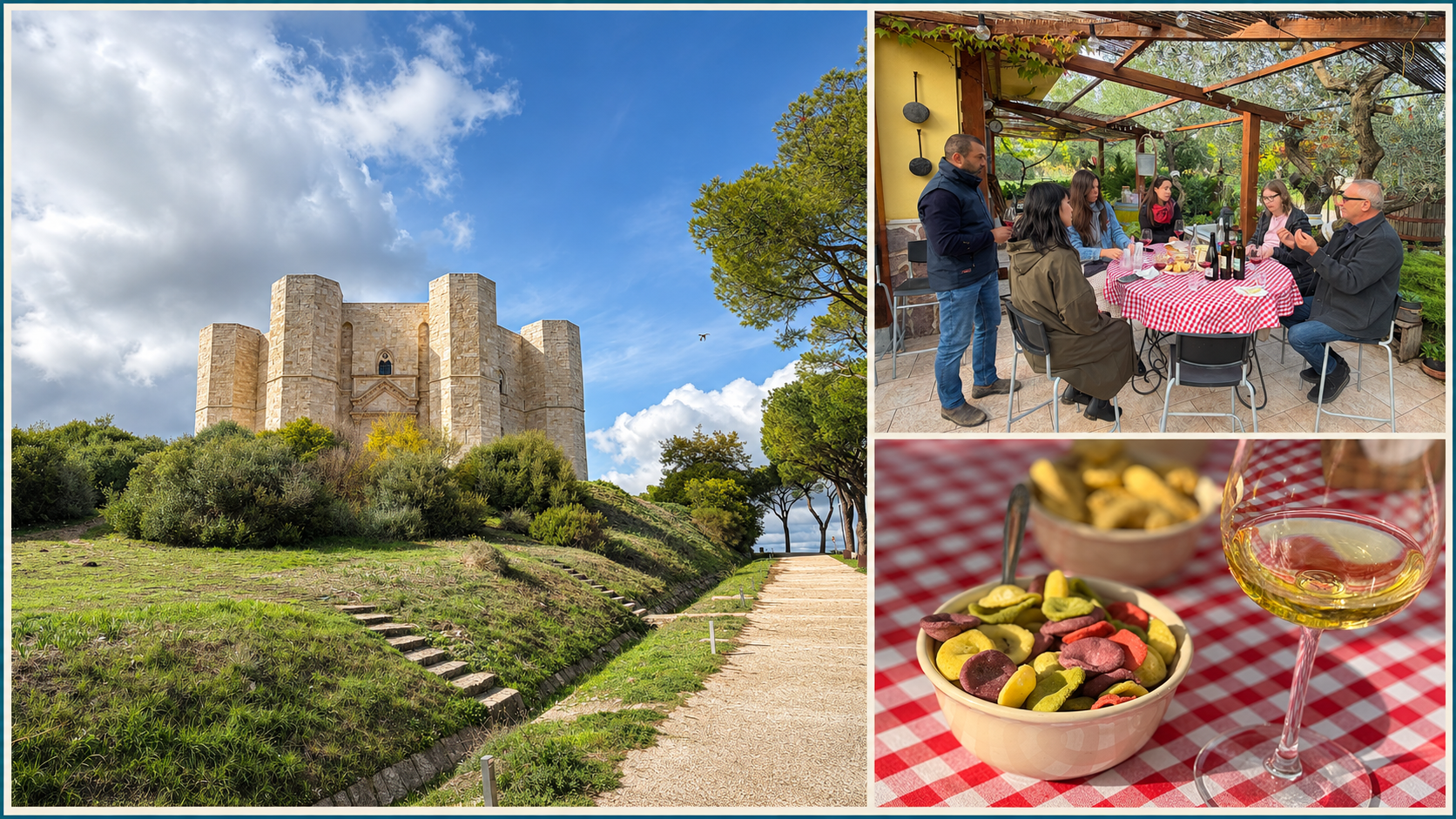
Castel del Monte rises alone on its hilltop; the remarkable octagonal castle of Emperor Frederick II built in the thirteenth century. Its perfect geometry still feels mysterious, and seeing it in person, against the wide Murgia sky, is unforgettable.
Mottola, perched high on its hill and long known as the "Spy of Puglia" for its sweeping views, hides a treasure of ancient rock churches carved into the surrounding ravines, their walls still holding traces of centuries-old frescoes.
Putignano charmed me with its historic center and its famous Carnival, one of the oldest in Europe, which gives the town a spirit of celebration year-round.


A Perfect Ending at Dopolavoro
Every great journey deserves a beautiful last chapter, and ours was written at Dopolavoro, a wonderful enoteca that was the perfect place to finish four days of discovering the heart of Puglia. Glasses were raised, stories were traded, and we lingered at the table the way the Pugliese do, in no hurry at all for the evening to end.


As I rode the train back north, I realized I was bringing home more than bottles of wine and olive oil. I was bringing home a new way of tasting, and of seeing. In Puglia, the table is not just where you eat. It is where you are welcomed, where stories are told, and where strangers become friends over a shared glass.
So pull up a chair, settle in, and let the heart of Puglia embrace all of your senses.